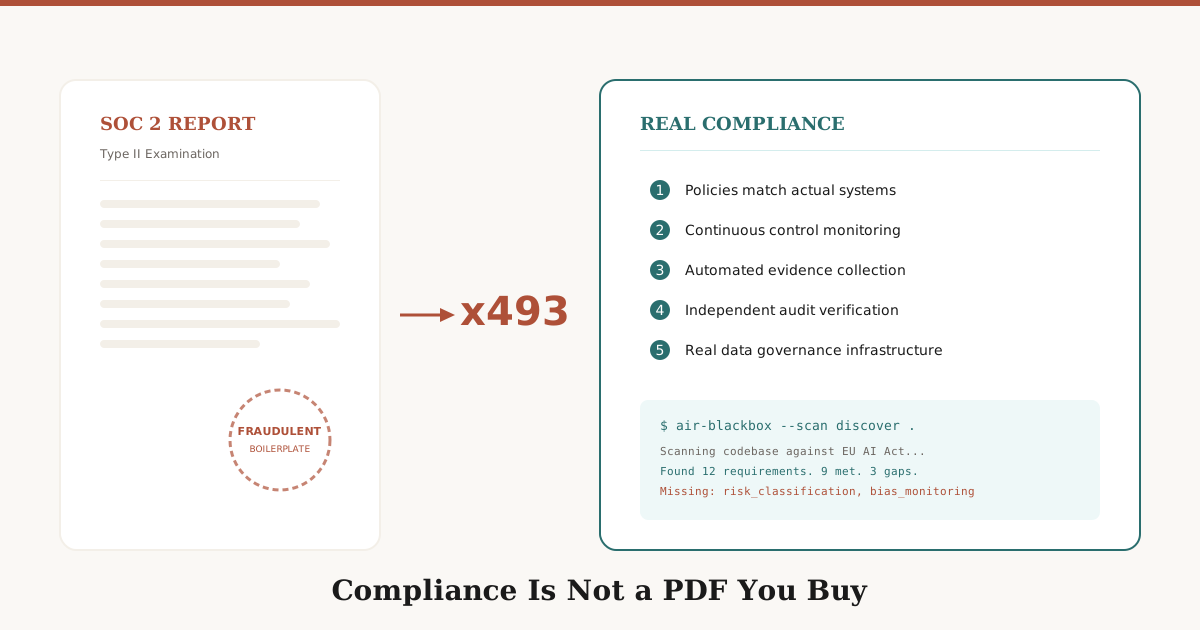
A YC-backed startup raised $32M to "automate compliance."
They issued 493 companies fraudulent SOC 2 reports in six months.
Let that sink in.
The Fraud
Delve generated auditor conclusions before any auditor reviewed evidence. 493 out of 494 reports used identical boilerplate — same grammatical errors, same nonsensical sentences. The only thing that changed was the company logo.
Their "US-based CPA firms" were Indian certification mills operating through shell companies. Every single Type II report claimed zero security incidents, zero personnel changes, zero customer terminations.
When the leak dropped, the CEO called the allegations "falsified claims" from an "AI-generated email."
Meanwhile, the leaked reports contained private signatures and confidential architecture diagrams from the very companies they were supposed to be protecting.
What This Actually Means
Companies relying on those reports now face criminal liability under HIPAA and fines up to 4% of global revenue under GDPR — for compliance violations they thought were resolved.
Read that again. These companies paid for compliance. They received official-looking reports. They presented those reports to customers, partners, and regulators. And now every single one of them is exposed.
This isn't a theoretical risk. This is 493 companies with fraudulent compliance documentation sitting in their files right now. Any regulator, any auditor, any opposing counsel in a data breach lawsuit can pull those reports and immediately see they're worthless.
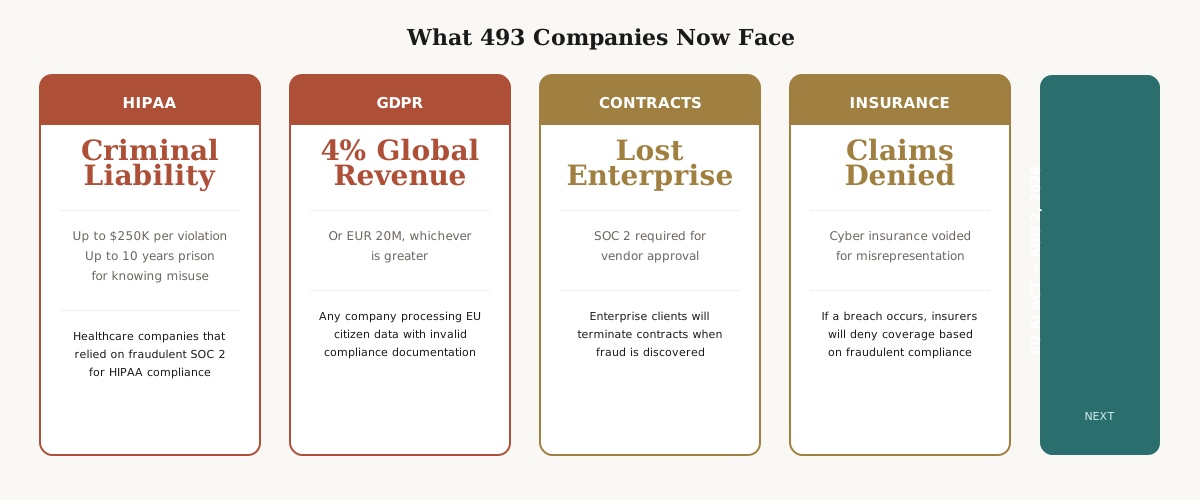
The damage isn't limited to fines. It's:
- Lost enterprise contracts that required valid SOC 2 certification
- Insurance claims denied because compliance was never actually achieved
- Personal liability for executives who signed off on vendor due diligence
- Customer lawsuits if a breach occurs and the "compliance" turns out to be a rubber stamp
- Criminal referrals under HIPAA for healthcare companies that relied on these reports
Why This Keeps Happening
The compliance industry has a fundamental problem: it sells documents, not outcomes.
SOC 2 was designed to be a rigorous, evidence-based audit of your security controls. But the market turned it into a checkbox exercise. Companies don't want compliance — they want the PDF that says they're compliant. And an entire ecosystem of vendors evolved to sell them exactly that.
Delve took this to its logical, fraudulent conclusion. But the underlying dynamic exists everywhere:
Consultants who sell compliance as a one-time project instead of an ongoing discipline. Audit firms that rubber-stamp reports because the client is paying them. SaaS tools that auto-generate policies nobody reads. Certification mills that exist solely to produce the document that closes the enterprise deal.
The result is an industry where the document and the reality have almost nothing to do with each other.
What Real Compliance Looks Like
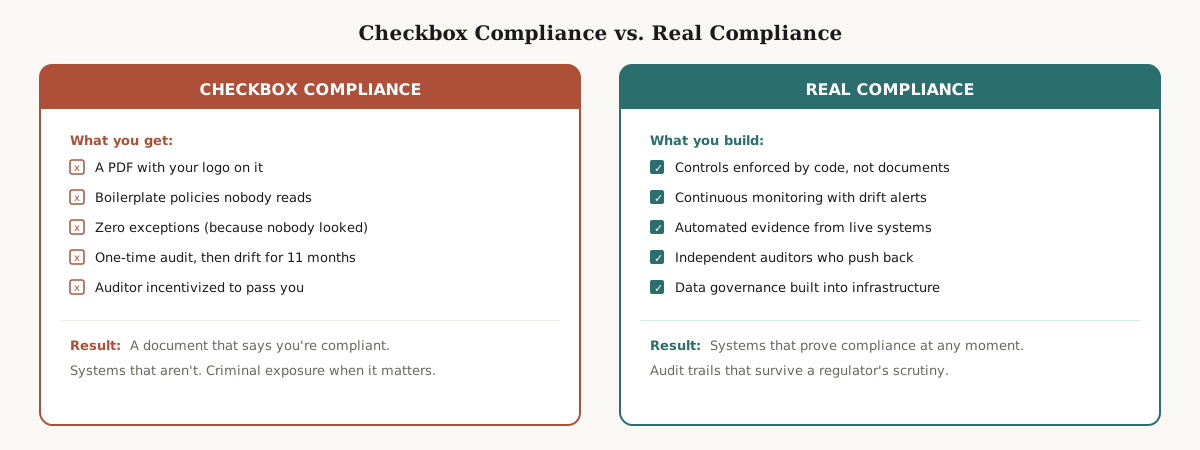
Real compliance isn't a report. It's what your systems actually do. Every day. Without someone watching.
Here's what that means in practice:
1. Your Policies Must Match Your Systems
It's not enough to have a password policy document. Your authentication system must enforce it. Your logs must prove it. Your access reviews must verify it.
If your policy says "MFA required for all production access" but your AWS console accepts password-only logins, you're not compliant. You have a document that says you are. That's worse than having nothing — it's evidence of negligence.
2. Your Controls Must Be Continuous
SOC 2 Type II covers a period, not a point in time. That means your security controls need to be operating continuously, not just when the auditor shows up.
This is where most companies fail. They scramble before the audit window, get everything in order, then let it slide for the rest of the year. A real compliance program monitors controls in real time and alerts when something drifts.
3. Your Evidence Must Be Automated
Manual evidence collection is where fraud hides. If a human is assembling screenshots and writing narratives for every control, there's room to fabricate, omit, and embellish.
Automated evidence collection — pulling directly from your systems, your logs, your configurations — creates an audit trail that's much harder to fake. It also makes compliance sustainable instead of a quarterly fire drill.
4. Your Audit Must Be Independent
The auditor's job is to challenge your claims, not confirm them. If your auditor is incentivized to pass you (because you're paying them, because they need the volume, because they're a certification mill), the entire system breaks down.
Look for auditors who push back. Who ask hard questions. Who flag findings. A clean audit report with zero exceptions should make you nervous, not relieved.
5. Your Data Governance Must Be Real
GDPR, HIPAA, and the upcoming EU AI Act all require you to know what data you have, where it lives, who can access it, and what happens to it. This isn't a policy question — it's an infrastructure question.
Can you produce a complete export of a user's data in 30 days? Can you prove that deleted data is actually deleted? Can you demonstrate that your AI systems process personal data lawfully? If the answer to any of these is "we'd have to figure that out," you're not compliant.
The Eu Ai Act is Next
The EU AI Act enforcement deadline is August 2, 2026. This isn't SOC 2 — there's no industry of friendly auditors to rubber-stamp your way through it.
The Act requires technical documentation of what your AI systems actually do. Not what a sales deck says they do. Not what a consultant wrote in a Word document. What the code does. What the training data contains. How decisions are made. How bias is monitored. How humans can intervene.
This is the Delve lesson applied to AI: if your systems can't prove what they do at the code level, a PDF report won't save you.
Tools like AIR Blackbox (open source, runs locally, reads your Python codebase against EU AI Act requirements) exist specifically because the compliance-as-a-document model is broken. The future of compliance is automated, continuous, and code-level.
How to Actually Get Compliant
If you're reading this and thinking "we might have this problem," here's what to do:
Step 1: Audit your auditor. If your SOC 2, ISO 27001, or any other compliance certification came from a firm you've never heard of, through a vendor that made it suspiciously easy, pull the report and verify the firm independently. Check their AICPA registration. Call them directly.
Step 2: Map your actual controls. Forget what the policy document says. Walk through your infrastructure and document what's actually configured. MFA settings. Access permissions. Encryption at rest and in transit. Log retention. Incident response procedures that have actually been tested.
Step 3: Identify the gaps. The distance between your documentation and your reality is your compliance risk. Every gap is a potential finding, a potential fine, and a potential breach.
Step 4: Build continuous monitoring. Compliance isn't a project with a start and end date. It's an operational discipline. Set up automated checks that verify your controls are operating as described, and alert you when they drift.
Step 5: Prepare for the AI Act. If you're building or deploying AI systems, start documenting now. Risk classification. Training data provenance. Decision transparency. Human oversight mechanisms. The August 2026 deadline will arrive faster than you think.
HOW uCreateWithAI CAN HELP
This is exactly the kind of problem we help companies navigate.
At uCreateWithAI, we don't sell compliance documents. We help you build systems that are actually compliant — and can prove it.
Our approach:
DATA GOVERNANCE BUILT IN. Our platform includes full GDPR infrastructure: user data export, right to deletion, anonymization, audit logging, data retention policies, and email preference management. These aren't policies in a binder — they're features in the software, enforced by code, with audit trails.
COMPLIANCE GUIDANCE, NOT COMPLIANCE THEATER. We work with small businesses, organizations, and franchises to understand their specific regulatory obligations and build the technical controls to meet them. No boilerplate. No copy-paste policies. Actual implementation.
AI SYSTEMS THAT DOCUMENT THEMSELVES. Our AI review pipeline, assessment engine, and automation modules are built with transparency and accountability in mind. Every AI decision can be traced, reviewed, and explained — which is exactly what the EU AI Act requires.
ONGOING SUPPORT, NOT ONE-TIME AUDITS. Compliance drifts. Regulations change. New systems get deployed. We provide ongoing guidance to keep your compliance program current, not a binder that gathers dust on a shelf.
Whether you're a startup that just realized your SOC 2 report might be worthless, a healthcare company worried about HIPAA exposure, or an organization preparing for the EU AI Act — we can help you build compliance that actually works.
Because compliance isn't a PDF you buy. It's what your systems actually do.
The Bottom Line
The Delve scandal isn't an anomaly. It's the inevitable result of an industry that optimized for documents instead of outcomes.
493 companies are now exposed because they trusted a vendor to hand them compliance instead of building it into their operations. Some of them will face fines. Some will lose contracts. Some will face criminal referrals.
Don't be company 494.
Build real controls. Monitor them continuously. Automate your evidence. Verify your auditors. And start preparing for the regulations that are coming — because after August 2026, "we bought a report" isn't going to be an acceptable answer.
If you need help getting there, that's what we do. Reach out at ucreatewithai.com or schedule a consultation through our platform. We'll help you build compliance that survives contact with an actual regulator.
Get posts like this in your inbox
No spam. New articles on AI strategy, governance, and building with AI for small business.
Keep Reading
Data and Metadata Governance in the Age of the EU AI Act: What You Should Be Doing Right Now
The EU AI Act doesn't just regulate AI models — it regulates the data that feeds them. Organizations that neglected data governance are about to pay the price. Here's what to prepare, what went wrong before, and why governing AI tools is no longer optional.
Your Data Isn't Ready for AI Agents. Neither Is Anyone Else's.
MIT Technology Review reports that only 1 in 10 companies can actually scale AI agents. The bottleneck isn't the models. It's the data underneath them. Here's what that means if you run a small business.
The AI Governance Gap: The Hard Questions the World Still Hasn't Answered
AI is advancing exponentially. Governance is not. Across jurisdictions, industries, and institutions, major questions remain unsettled. Here is a structured view of the eight governance gaps shaping the AI economy today — and why the next competitive advantage will be stronger governance architecture, not better models.